Thursday, 6 September 2018

Money to burn

What's the best way to squander £90 million? Simple - relaunch your local bus service with flashy new buses that aren't needed and aren't any quicker than the old buses.

To a fanfare of hype and gushing soundbites, along with free doughnuts, our local number 4 bus route in East Belfast was relaunched this week with purple bendy buses, pre-paid journeys and  drivers who no longer interact with the passengers.

I sampled the new bus earlier in the week and was totally underwhelmed. When I tried to validate my bus pass, the machine said it was faulty. Not a problem though as I could board the bus and travel to my destination without meeting any ticket inspectors (apparently there are very few).

Unlike the old buses, all the seats were taken so like many other passengers I had to stand for the whole journey to the city centre - which at around 15 minutes was no shorter than previously. The bus lanes now operate all day but that didn't make the bus any quicker.

So £90 million was spent on buses that offer no visible improvement on the old buses, and will be a magnet for fare dodgers who can hop on and hop off tourist-style. It will be fun to see how many journeys I can make without seeing a ticket inspector (now grandly renamed as Revenue Protection Officers).

The bendy buses are also less flexible than the old double-deckers. On tight corners they have to swing right into the middle of the road to clear the kerb. And there are plenty of tight corners in the city centre.

Just think what we could have done with £90 million if it hadn't been squandered on this pointless exercise. In particular it could have drastically reduced hospital waiting lists, which are shockingly huge (I had to wait 18 months for a routine prostate operation).

Spending scandals? I'm sure there'll be another one along in a minute....

Sunday, 2 September 2018

Driven crazy

A journalist has compiled a handy list of all those everyday annoyances we come across - those things that drive us crazy but usually we can't do anything about, unless we're ready for an angry argument.

Here's a selection of his petty irritations:

1) Kisses from people you've never met
2) People who board trains (or buses) without letting people off first
3) Out-of-control children in restaurants
4) Loud phone talkers on public transport
5) Losing the end of the cling film or sellotape
6) Automated checkouts (there's always a problem)
7) When you can't remember your passwords
8) Other people's personal noises (tapping on table, sniffling etc)
9) Food served on wooden boards
10) People who suddenly stop dead on pavements
11) Slipping-down socks. And itchy bras
12) Bags on seats when others are standing
13) Litter droppers
14) Packets of food slightly too much for your storage jar
15) Train announcements - long, rambling, unintelligible
16) Drivers who take up two parking spaces

I'd agree with most of those. But which ones really exasperate me? Out-of-control children maybe, especially if the parent is oblivious to what they're doing. And people who stop dead on pavements, or walk at a snail's pace when you can't get past them. And food served on wooden boards. Firstly, what's the point, and secondly, how hygienic are they?

I've always enjoyed kissing, so I'm happy to accept kisses from just about anyone, be it in the flesh or on social media. But I would draw the line at smelly old drunks. And I prefer a kiss that isn't accompanied by an unnecessary kissing noise like "Mwergh". Why do people do that?

I'm not too bothered by loud phone talkers, unless they're discussing the clap clinic or their bowel habits. Their strange conversations can be quite entertaining, especially if they're having a heated argument with their spouse/ girlfriend/ boyfriend.

Your everyday annoyance might be my unexpected pleasure.

Monday, 27 August 2018

Believe it or not

I'm intrigued to read that religious faith is on the rise around the world and 84 per cent of the world's population identifies with a religion. I'd had the impression that religion was declining and non-believers were increasing.

That may be so in some countries - the number of people in the Irish Republic who disclaim any religion has risen by 200,000 - but elsewhere the number of believers has leapt.

As my regulars will know, I was put off religion at an early age, firstly as the idea of a supreme being or cosmic plan made no sense to me, and secondly because the everyday behaviour of believers belied their professed religious principles. They would exude moral superiority but treat others with disdain.

My fellow boarding-school pupils would profess religious devotion while bullying me at every opportunity. The boys I was closest to, who were always kind and respectful, had no interest in religion - they just believed in common decency.

I hasten to add that despite the off-putting phoneys, of course there are many believers who not only live up to their principles but do a huge amount of charitable work, without making any song-and-dance about it. I know several of my blogmates are deeply religious and I respect their personal beliefs even if I don't share them.

We all need help and encouragement to get through the ups and downs of life, and if religion is your chosen guide, then good luck to you. I'm not proposing a ban on religion any time soon.

I know religious charities do wonderful work, and when we get doorstep visits from the Salvation Army or St John Ambulance, we always happily give them a donation. I thoroughly applaud those religious charities helping refugees all over the world, like Christian Aid, Sisters of Charity and the Knights of Columbus, as refugees face the most dreadful situations.

Whatever floats your boat, as they say.

Tuesday, 21 August 2018

Just trust me

It surprises me to realise there's no official system for monitoring the carrying-out of wills, for ensuring the right amount of money goes to the various recipients and there's no funny business going on, nobody siphoning off large sums they're not entitled to.

As the executor of my mum's will, it's entirely up to me to make sure the money is passed on to the three beneficiaries as it should be, and I'm not stealthily whisking the odd £10,000 into my own bank account. As far as I know nobody in authority is going to check I'm doing things properly.

My mum left a lot of money to her half-brother. None of the family have met him and nobody, including him, knew he had been left any money. We could in theory have ignored the legacy and divided it between the rest of us. Or we could have told him he'd only been left £100. Who would know? How would the long arm of the law ever find out? But of course we're all honest and he'll get what he's meant to get.

As far as I can see, an irregularity only comes to light if someone challenges the will and claims some sort of fraud. And they can only do that if they've seen the will. If they haven't seen it, they would have to contact the probate registry, which has custody of every original will.

It's also entirely up to me to declare the right value of my mum's estate to the tax authorities. I haven't been asked for documentary proof, so I could in theory have undervalued her estate by thousands of pounds, paid a lot less tax, and passed on more money to the beneficiaries. But again I'm honest so I told the truth. Perhaps the tax people make secret checks with the banks to confirm what I've told them?

All I can say is that a lot of people are simply trusting me to do things properly. Which is remarkable in a society where constant suspicion is widespread.

Friday, 17 August 2018

Masculine traits

Leftie men like to give the impression that the way they treat women is thoroughly sensitive and liberated, unlike those awful right-wingers who're misogynists through and through. Leftie men are proud of their feminist credentials. They've shed all those primitive masculine traits. Or so they like to think.

The truth is that the powerful tentacles of masculine conditioning aren't shed that easily - if at all. They've been embedded in the male mind from a very early age - from birth in fact - and by the time adulthood is reached they're well dug-in and pretty hard to shift.

I know my own mind is warped by my masculine upbringing, and it would be stupid to pretend otherwise. I was taught that women should be seen in a certain way - that they should be objectified, fetishised, sexualised, pornified, commodified, trivialised, ignored, ridiculed, controlled and dominated. That's a hefty rejection of decent, healthy behaviour towards half the population, and not something that can just be shed overnight like torn jeans or a faulty kettle.

At the age of 71, I'm very aware that those disgusting misogynistic attitudes still hover at the back of my mind, however much I might pretend they've been thoroughly purged and forgotten. But unlike the men who still see those attitudes as normal and mindlessly act on them, I can at least clearly recognise the hatred of women that runs through them and consciously adopt different and more civilised behaviour.

When women angrily point out my residual anti-women habits, as they sometimes do, it's a timely reminder of that stubbornly entrenched conditioning that I might otherwise think the passing years have obliterated. If only. Unfortunately society did a bloody good job of indoctrinating me at a tender age when I was too ignorant to realise what was being fed into me.

PS: I think trying to shed masculine conditioning is like trying to shed a Catholic upbringing - virtually impossible.

Wednesday, 8 August 2018

Tying the knot

I'm surprised marriage is still so popular, when cohabiting is now seen as perfectly normal - unlike in my younger days when it was still frowned upon. In fact my own father so disapproved of me and Jenny cohabiting in the 1980s that he left me nothing whatever in his will.

In 2015 the number of marriages in England and Wales had fallen by 40 per cent from 1947, the year I was born. But there were still 239,000 marriages, many of them elaborate affairs with exotic locations, lavish catering and all the trimmings.

Clearly marriage is still very meaningful to a lot of people. For me it's just some solemn promises in a suitably solemn venue, but for others it's a lot more. It marks a major turning point in their life, a huge transition and a huge commitment to another person.

Jenny and I cohabited for 14 years, and intended to carry on that way. We knew we loved each other and we didn't need a piece of paper to confirm it. But as I've explained before, we faced a minor crisis when Jenny's employer said that if she died her occupational pension could only go to a spouse and not to a cohabiting partner or significant other. So we bit the bullet and got married. What you might call a bit of creative accounting.

I think many people still believe that cohabiting amounts to something called common-law marriage, which gives you the same legal rights as those who are married. In fact cohabiting couples have no legal protections whatever, which may be one reason marriage is still popular.

I suspect it's also the celebrity effect. People see celebrities having extravagant weddings and want to do the same. Quiet devotion isn't enough. They want their day of glitter and glamour to prove they're serious. And can still look stunning in a wedding dress*.

*and that's just the men....

Sunday, 5 August 2018

A slippery slope

I'm not good at self-indulgence, at enjoying myself freely and spontaneously. I always hold back, as if too much personal fun might be a bit decadent and immature.

I see other people letting themselves go so eagerly - boozing, bingeing, joking, raiding the shops, cheering football teams - I'm taken aback. I'm seldom that enthusiastic or uninhibited about even my biggest passions. A sort of quiet pleasure is all I can manage.

I guess I come from that social background where too much obvious enjoyment was seen as "showing off" or "drawing attention to yourself". All horribly undignified and childish. Enjoyment was fine up to a point, but not if it meant "making a spectacle of yourself". That would never do. I'm trapped by the stiff upper-lip tradition of the English middle classes.

A part of me thinks too much enjoyment is the slippery slope to total debauchery and public humiliation. One drink too many and I'll end up an alcoholic. Too much cheesecake and ice cream and I'll be a 20-stone fatty in days. Just go too far and in a trice I'll be like a runaway car.

Maybe I'm influenced by occasions when enjoyment turned sour. I once drove a girlfriend home when I was roaring drink and could have killed us both. Another time, on a heavy dose of LSD, I was oblivious to traffic and almost killed myself again. I've played practical jokes and seriously upset the victims. Such memories make me wary of too much abandon.

But I do my best. When others around me are getting wilder and wilder, I tell myself to loosen up and get in the swing of it all. Come on, Nick, throw away the rule book, forget all those childhood vetoes and indulge your natural impulses. And the result? A bit like a lifelong virgin sampling a brothel. It's hard to change the habits of a lifetime.

Sunday, 29 July 2018

Vow of silence

I'm still subject to an indefinite gagging order I signed when I left a well-known charity ten years ago. I had to sign it as part of a voluntary redundancy package and it stays in force until the day I drop dead. It forbids me from saying anything about how the charity was run and any disturbing incidents I witnessed while I was there.

Not only that but it forbids me from even revealing that I signed a gagging order or what the order specifies, which means that right now I'm breaking the law. But given I'm not revealing anything too damaging, and not naming the charity, I doubt if a solicitor's letter will drop through my front door any time soon.

The order also forbids me from making disparaging comments about the charity or taking any legal action, such as claiming unfair dismissal, claiming the national minimum wage or claiming age discrimination.

I gather gagging orders are getting more and more common, especially when someone is leaving a workplace, possibly under a cloud and probably knowing of all sorts of negative things that could wreck the organisation's reputation. Even sexual harassment can be hushed up by such orders.

In June it was revealed that the House of Commons spent £2.4 million on 53 redundancy-related non-disclosure orders in five years.

Well, just to carry on breaking the law, I can disclose that my own gagging order followed a severe personality clash between several workmates, and a new manager's desire to clear out those of us he regarded as "dead wood" in order to hire people more to his liking.

Hardly explosive revelations, especially as similar things must go on in every charity in the land. So a voluminous five-page gagging order is absurdly over the top.

But it's a nice little earner for the lawyers.

Monday, 23 July 2018

Seize the time

I'm not a procrastinator. I don't put things off until next week or next month or some time in the distant future. If I have something to do, I like to do it right now and get it out of the way.

I get very frustrated when I can't act immediately. Because I have to wait on someone else for permission or guidance or paperwork. Because it's the weekend and offices and shops are closed. Because the person I want is off sick or on leave. Or a dozen other things that stop me in my tracks.

Unlike procrastinators, I don't like things hanging over me. I like things to be disposed of as quickly as possible so I can feel relaxed and unburdened.

I suppose it's partly an irrational fear that if I get into the habit of delaying things, in no time I'll have a list of outstanding tasks as long as my arm and I'll be hopelessly overwhelmed.

Also I don't see the point of procrastinating. The job has to be done eventually, so why not right now? I guess a lot of procrastinators hope that if they wait long enough the job won't need to be done any more, or someone else will have done it.

It's equally frustrating when others are procrastinating. I've been waiting seven weeks for a partial refund of my mum's care home fees, but the company concerned is in no hurry to settle things. They would rather keep me dangling until such time as they feel like sending me the money.

There must be others like me who like to do things promptly. But oddly, there seems to be no word for us. Promptinator? Promptarian? Promptian? We're the tendency without a name, the missing word in the dictionary.

Thursday, 19 July 2018

Forgive and forget

It astonishes me what some people can forgive - even the most appalling and extreme behaviour that on the face of it seems totally unforgiv-able.

Personally I don't forgive or forget easily. Why would I forgive someone who's deliberately and knowingly treated me badly and thought that was okay? I won't forgive and forget, though at the same time I don't nurse grudges and I don't get sour and bitter. I just put it behind me and get on with my life.

Yet other people are able to forgive the most shocking things and just carry on as normal as if nothing has happened. Or at least nothing that awful.

A Texan woman, Nancy Shore, says she has forgiven her ex-husband Frank for having a secret mistress for three years, hiring a hit man to murder her, causing her to lose her left eye after being shot in the head, and denying he had anything to do with the attack.

She is a devout Christian and attributes her ability to forgive to her deep faith. She says she still loves him and would have tried to rebuild the relationship if he hadn't been found guilty and jailed.

Of course you can never be sure how you would react in some entirely unexpected situation such as that one, but I really couldn't see myself forgiving Jenny for hiring a hit man or having a clandestine three-year affair. How could I forgive such systematic deceit and deviousness and hatred? I'm amazed that anyone could.

Yes, we're all human, we all do dreadful things, we all act abominably at times, but outrageous behaviour on that scale? It implies such sheer contempt for his wife.

It's not the first time I've read of someone forgiving something utterly indefensible, and it won't be the last. It always has me scratching my head in disbelief.

Pic: Nancy Shore

Sunday, 15 July 2018

Toxic air

Jenny and I live very close to three schools, which means that twice a day during term time the local streets are jammed with cars as parents drop off and pick up their little darlings.

Now I read that thousands of schools across Britain are taking measures to end the parental school run because of the serious air pollution it causes. It harms children's lungs and drives up hospital admissions and GP visits. A nine year old London girl died recently of asthma after a spike in air pollution around her home.

Schools are banning school runs, encouraging walking, cycling and scooting, and asking parents to park a few minutes' walk from the school.

We've been living here for nine years and haven't yet had any personal health problems related to air pollution, but who knows what hidden damage might be going on? Unfortunately air pollution isn't usually visible so it's easily ignored.

As far as I know, not a single school in Northern Ireland is taking any measures to limit school runs and air pollution. So I intend to write to the nearby schools and ask them if they have any plans to reduce school runs.

It has to be said that the general attitude to air pollution in Northern Ireland is pretty lax. People are accustomed to driving long distances for work or to visit relatives, and they turn a blind eye to the resulting pollution. That really needs to change.

How will the schools respond to my letters, I wonder? Watch this space.

Tuesday, 10 July 2018

Weighing it up

I've sat on a jury several times, but I'm not convinced a jury is any more reliable than a judge when it comes to the verdict being the right one. Both judges and juries are fallible and both can get it horribly wrong.

I'm glad I never landed a really serious case like gang rape, serial killing or sexual trafficking. The responsibility to reach the correct verdict, and to deal with some thoroughly nasty characters, possibly with the whole world watching, would have been nerve-racking. As it was, my cases were relatively minor ones - affray, physical assault, obstructing the police.

Who knows if our verdicts were the true ones? Only the defendants and victims could ever be certain. In one case, a single juror persuaded the rest of us the defendant was guilty rather than innocent. Was she right or were we all taken in by her smooth talking? I have no idea.

I'm also glad I never got a case that went on for months, as some do. I was almost picked for the Jeremy Thorpe trial in 1979, which lasted six weeks, but the person just before me in the queue was approved as juror number twelve.

Jurors are still banned from discussing completed cases. They can't say how they assessed the evidence and how they arrived at the verdict. Regrettable in a way, since we'd all love to know how  an especially controversial verdict was reached. But probably also sensible, since our faith in juries would be rapidly undermined if we discovered that blatant prejudice or the desire to get home again were the main considerations.

But after some serious thinking about my jury experience, I concluded that in the end the crucial factor isn't whether it's a judge or jury that decides, it's the quality of the evidence. Whichever side has the strongest and most compelling evidence will prevail, whoever is weighing it up.

Tuesday, 3 July 2018

Up for grabs

One very noticeable aspect of growing older is that I no longer take so much for granted. I'm much more aware of the imperman-ence of everything, that however solid something seems, it could collapse at any moment.

As a child, I took most things for granted - my parents' relationship, my home, my school, my physical and emotional well-being, having enough money, living in a peaceful country and a dozen other things. It never occurred to me that some unfortunate twist of fate could end them all tomorrow.

As I grew older I became aware of the fragility of all these supposedly rock-solid circumstances. Relationships could end, my home could be repossessed, I could develop some crippling illness, my country could go to war. Whether one's life was going well or going badly depended on personal effort and also on luck.

My parents didn't just magically stay together. They had to work at the relationship, at dealing with their differences. My home was only there as long as the mortgage was paid. My well-being relied on my parents' love and affection. And so on. I gradually realised that all these apparent "givens" were not given but painstakingly arrived at.

And I took things for granted not just in the sense of assuming an inherent permanence but in the sense of not fully appreciating them for what they were. I didn't realise how lucky I was to have a supportive and settled home life when thousands of people are orphans or refugees or live on the streets. I wasn't aware of how privileged I was.

No longer taking things for granted is both scary and exciting. Scary because I realise just how easily my life could implode, exciting because everything's up for grabs and everything's negotiable.

My life could change utterly in the twinkling of an eye.

Friday, 29 June 2018

Doctor gorgeous

Every day I hear of another extraord-inary misuse of social media, of some new trend that's utterly repugnant and anti-social.

The latest fad is to post photos and videos of female doctors online and ask people to rate their attractiveness. Which one's hottest, Doctor Deborah or Doctor Alison?

Apparently it's okay for patients to video their consultations, for instance to record baby scans or their child's first GP appointment or help them remember what was discussed or what treatment was recommended.

But some patients are making videos, sometimes without express permission, and then staging online beauty contests. Doctors revealed their alarm at the British Medical Association's annual meeting.

What sort of people think this is acceptable? A doctor's life is hard enough without their being subject to a sleazy online parlour game - a game they may not even realise is happening unless someone tips them off.

Those idiots who think it's all very amusing fully deserve to be struck off their GP's list. Or perhaps to have their own attractiveness, or lack of it, rated by a bunch of uninhibited women.

It's never even occurred to me to video my consultations. They can be quite detailed, but I do my best to remember everything that comes up and make a note immediately afterwards of what the doctor said. That seems to work very well - my note always includes the most important points.

I assume a doctor can contact Twitter or Facebook or whatever and ask for the offending images to be removed, but maybe that's not the case.

My own doctor (that's Dr Joanne) is very competent and very thorough. What she looks like is of no significance.

Monday, 25 June 2018

Urban delights

I'm a 100 per cent urban person. I thrive on cities and all the amenities and attractions they offer. I can't imagine myself living in some remote rural location lacking all the urban advantages I'm used to.

It would drive me mad having to travel miles to get the simple things like shampoo or a pillow case, or to see a dentist or solicitor or hairdresser. It would be a perpetual worry that if I fell seriously ill, the nearest hospital might be so far away I might die in transit.

I would be hopeless on a farm. I have no natural abilities for what's involved. I've tried milking a cow, moving goats and pigs, and shearing sheep, and I'm useless at all of them. I would soon be defeated by the sheer flat-out hard work and early starts.

I'm currently reading about someone who feels totally at home in the Orkney Islands, with the often terrible weather and physical isolation, and I wonder what's the big attraction of that kind of life. She couldn't be more different from me.

I've always lived in a city - first London and then Belfast. I'm so accustomed to the benefits of urban living that doing without them is unthinkable. I'm so used to nipping to the local shops for a coffee, a pizza, a haircut or a kettle. I'm so used to frequent buses to the city centre for anything else. I'm so used to the nearby health centre and the nearby hospital. I'm so used to the abundant art and culture. How could I say goodbye to all that?

I'm sure it very much depends on your upbringing. If you were raised in a city, you're likely to stay in a city. If you were raised on a farm, you're likely to become  a farmer. If you were raised in the Scottish Highlands, you're likely to live somewhere similar.

Me, I'm an unrepentant city dweller. I would never swap skyscrapers and ring roads for barns and haystacks.

Thursday, 21 June 2018

Phone moan

Once again teachers (and parents) are calling for mobile phones to be banned on school premises, for numerous reasons including not disrupting lessons, reducing bullying, preventing exam cheating, and limiting access to harmful websites.

That seems sensible to me. Whatever you see as the function of schools - passing exams, acquiring knowledge, learning to think, learning to be creative, picking up life skills - mobile phones have no part to play, and may actually be detrimental. So why are they permitted?

At the risk of sounding like grandad, I have to say that I never had a mobile phone when I was at school, and I don't feel I was deprived. I don't think I would have gained anything by having a Facebook page or checking my emails or looking at another twenty cat pictures.

But some people seem to think that banning mobile phones would be some sort of draconian act, denying personal freedom, telling people what to do etc. Which just seems like a crazy over-reaction to a common-sense suggestion. Schools aren't about personal freedom anyway, they're about acquiring skills.

It's also argued that parents and children need to be in touch with one another in case of an emergency like an attempted sexual assault, a sudden illness or a death in the family. Well, I don't recall any such emergency when I was at school, or if there was one, a teacher would have phoned my mum or vice versa.

I guess a mobile phone might have been handy when my teachers were droning on about something hopelessly boring like quadratic equations or tidewater glaciers. I could have furtively checked out which pop star had been busted for drugs or fallen off the stage or split their pants or set fire to their guitar.

But then again, I probably wouldn't have learnt very much.

PS: Algeria is disabling its entire national internet during the high school exam period from June 20 to June 25 to prevent phone cheating, which was widespread in previous years. In addition, all devices with internet access are banned from exam halls. Iraq has a similar policy.

Saturday, 16 June 2018

Dodgy authors

The regular controversy over whether famous books should be withdrawn or boycotted because of the author's question-able behaviour is once more in the news because publishers are increasingly putting morality clauses into their contracts.

Which makes me ask myself if I should be taking the same censorious attitude and weeding from my bookshelves all those authors whose personal lives are or were reprehensible.

Should I throw out anyone guilty of sexual misconduct or violence? Anyone using pornography or prostitutes? Anyone who has made racist or homophobic remarks? Anyone who supports extreme right-wing groups?

It's a difficult question. I wouldn't want famous books with a huge literary reputation to disappear forever simply because the author's personal behaviour is outrageous. I don't see what's wrong with praising the book while at the same time condemning the way they behave.

But then again, isn't that tantamount to saying the author's personal life doesn't really matter because they're a literary genius and their appalling behaviour can be swept under the carpet? That brilliant turns of phrase are more important than a battered wife?

There's a difference of course between living authors who we're judging by current norms and long-dead authors whose behaviour seems dreadful now but was probably less contentious at the time. Why should they be judged against today's more rigorous standards? It would be absurd to banish Dickens or Shakespeare or Tolstoy.

I don't intend to remove books from my bookshelves, books that I greatly enjoyed and may have re-read several times, because of the author's squalid behaviour. How many authors are beyond reproach in their personal lives? Not many, I suspect.

I'm very torn between strict censorship and a more pragmatic approach. Especially as censorship can all too easily escalate.

Pic: Lionel Shriver, who has been criticised for her views on diversity (Shriver herself says she has been "maliciously misinterpreted")
..................................................................................

Was in Cambridge yesterday (Tuesday) for my mum's cremation. Very simple, no service or tributes, just the coffin being dispatched, as my mum wanted. My niece and I were both crying copiously, the first time I've cried for a very long time. The coffin really brings it home that this is the end.

Sunday, 10 June 2018

Crows' feet and wrinkles

An American beauty magazine has decided to stop using the term "anti-ageing" as it suggests ageing is "a condition we need to battle" rather than a natural and normal process.

Well, I wish them luck with that. However much you change the language referring to it, physical ageing is still going to be something people dislike and fret about and try to reverse. Thousands of us will still peer in the mirror every morning and look askance at the wrinkles, crows' feet or double chin. Not many of us will dismiss what we see with a casual "che sera sera".

Though I tend to say "che sera sera" most of the time - well, I was never a glamorous male heart-throb in the first place - there are still times when I look at my battered, ancient appearance and think it would be quite nice to go back a few years.

It's hard not to dwell on the ageing process when the media focuses so obsessively on youth, on looking young and on "not showing your age". And when so many people are resorting to cosmetic surgeons to hold back the advancing years.

Of course I never thought about ageing when I was young. Old age seemed like something way into the future that would probably never happen. It never occurred to me that I might end up looking like those wrinkly old codgers on the bus. Then suddenly (or so it seemed - I barely noticed the gradual changes) I looked like an old codger myself and I thought, how did that happen?

Secretly I rather like the fact that my face looks lived-in, the outcome of a lifetime of hard knocks and challenges, a thousand swirling emotions, so many extraordinary and astonishing events. The face that knows a thing or two.

Anti-ageing cream? Thanks but no thanks.

Tuesday, 5 June 2018

Goodbye mum

So my mum died on Sunday at the age of 96. She seemed healthy enough when I visited her a couple of weeks ago, but an unexpected chain of events led to her going into hospital and dying four days later. There are questions over her death, which followed a fall at her care home, and a post-mortem is to be held. The doctors think she suffered either cardiac arrest or a stroke.

My mum and I were very much chalk and cheese, and we had very different views on all sorts of things, but we always kept in touch. Even when my father banned me from their house for several years, we met in a local pub, where we would sip some slightly alcoholic drinks and swap news. After he died I was able to visit her at home again.

It was sad to see her gradual decline from someone energetic, sharp-witted and curious to someone losing all interest in the outside world and often confused and uncomprehending. Not so long ago she was a keen member of the Ramblers Association and went on long hikes with other members. She went on regular seaside holidays and even a couple of cruises. She kept in touch with a wide circle of friends and acquaintances.

But growing physical weakness meant she had to abandon the Ramblers Association. She hadn't been on holiday for a while, no longer bothered to keep up with old friends, and complained increasingly of loneliness.

Since she'd never had any serious illness, and had never had any surgery apart from a tonsillectomy as a child, me and the rest of the family assumed she would reach 100 at least, but it wasn't to be. Fate intervened in disastrous fashion.

Goodbye mum. We knew each other for 71 years and that's quite something.

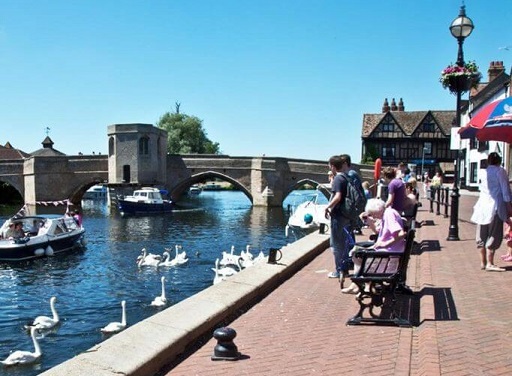
Pic: St Ives, Cambridgeshire, where my mum was living

PS: The post mortem concluded that she died of a UTI. Extraordinary. I imagine the UTI had been developing for a few days but the care home hadn't realised, and it was only after she was taken to hospital after the fall that the advanced UTI was diagnosed and by that time complications had set in. But we'll be asking some searching questions to find out exactly what happened.

Friday, 1 June 2018

An uphill struggle

It's surprisingly hard to change one's dietary habits. We're used to eating certain foods in certain quantities at certain times and altering that in any way can be an uphill struggle.

I'm fairly thin, but I can put on the pounds very easily. If I didn't keep a constant watch on my weight I could put on a stone or so quite quickly. But adjusting my diet to lose a few pounds is not that easy.

It seems simple enough to eat smaller portions or avoid fattening foods or skip a meal, but the reality is less simple. I might aim at a small portion but if there's more on offer it's too tempting. I love chocolate and ice cream and I'm not giving them up in a hurry. I'm attuned to three meals a day and giving one up is usually beyond me.

If you're used to having tiny portions, or not eating chocolate, or not having a midday meal, then you can just carry on. But if you're firmly in the grip of bad habits, breaking them can be tough.

Social events are treacherous, as there are always piles of unhealthy food - cakes, pastries, muffins, chocolates. It's only polite to nibble a few of them. Refusing everything on offer just prompts awkward questions.

I have at least broken the pack of biscuits habit. I used to eat an entire pack of biscuits at one go. Two or three weren't enough, I just had to keep eating until the pack was finished. Now I have one biscuit and that's it.

For most things, I have plenty of will power. But when it comes to serious dietary changes, will power deserts me. I need a ruthless Aunt Lydia to keep me in line.

*Aunt Lydia: the enforcer in The Handmaid's Tale
.......................................................................................

Thanks for all your kind thoughts about my mum. She died at 5.15 am this morning (Sunday)